
Finding Inspiration in Every Turn

MTL5910:
Responsible AI in Education Resource Guide
This resource explores the basics of AI, how to use AI responsibly, practical applications in education, effective prompting, ethical uses of AI, understanding bias and other risks, and preparing for the future of AI in education.
Feel free to use the provided information, illustrations, and infographics in your own work. If you do, please make sure to attribute and cite this work properly. To begin, click the AI 101 section and go from there!
Artificial Intelligence 101: Understanding the Basics
IBM said it best with their definition of AI: "Artificial intelligence (AI) is technology that enables computers and machines to simulate human learning, comprehension, problem solving, decision making, creativity and autonomy." To put it simply, AI is a tool that humans can use to simplify computer-aided tasks.
AI systems use a combination of different systems. Using software, data, and algorithms, AI systems perform tasks that normally require human intelligence. Humans serve as the input, and the systems serve as the output. It's important to understand that AI systems can be represented in various ways. Some of these systems include but aren't limited to: Machine Learning, Deep Learning, and Generative AI. In almost all cases and uses, a human must be involved in the process to help guide the input, alter inputs if needed, and evaluate the results.
The following chart gives a simple timeline of the creation and evolution of AI systems:
Another component of an AI system is that these systems generate conversations by using large language models (or LLMs) to learn how to understand and respond to humans. By using these LLMs, AI systems are exposed to and use a vast range of information developed by humans. These systems are very good at identifying patterns in their responses. When given a prompt or task, these patterns can help predict the system's responses.
An AI-assisted conversation works in this way:
Data → Pattern Recognition → AI Model → Response
It's important to keep in mind that AI systems do not think like humans. They solely rely on the data available and provided by users to identify patterns. These patterns are used to create responses based on a user's prompt or task. A human must always be involved to guide the prompt and/or task.
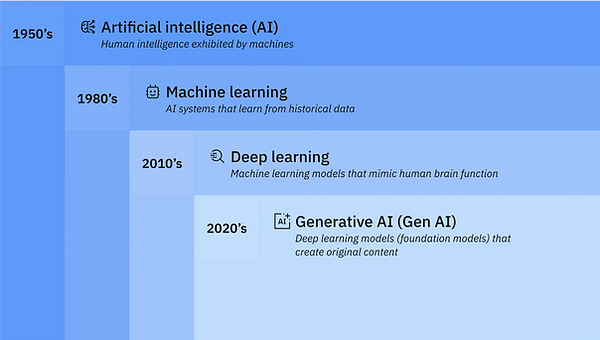
Image provided by IBM


As mentioned before, some of the AI systems available now include deep learning, machine learning, and generative AI platforms. The infographic shows a bit of how generative pre-trained transformer platforms (GPT) operate.
GPT platforms generate responses based on user input or task requests. They can use this input to create new content such as text, images, audio, video, and even code. While generated content can be fairly simple to create and use, users should never rely solely on generated content. Especially in an educational application, users should always "trust, but verify" their results. More on the various AI applications related to the educational process can be found in the "Practical Applications" tab/infographic.
The rapid evolution of many GPT-based platforms by companies such as Apple, Google, and many others. Some of these platforms have been developed into AI assistants that can help with even the most basic tasks. Assistants can help schedule tasks, summarize information, translate different languages, analyze content, support learning, and even help users with their writing.
While this technology can simplify the work we do, humans must always guide the process. Think of AI as a collaborative tool instead of one that can be used to replace human-created content and work.


Literacy and the Ethical Use of AI
AI literacy is knowing not just how to use AI, but how to critically analyze and understand AI systems. Another aspect of AI literacy is also knowing how to use AI responsibly and ethically. It’s knowing how, when, and where to use it. The end goal should be to use AI effectively and safely in both a person’s everyday and professional lives.
To best understand AI literacy, we’ll look at several resources. The first is the US Department of Labor’s AI Literacy Framework. This framework provides guidance for those developing their guidelines and seeks to provide proper literacy training across public workforces and educational systems. The DOL defines AI literacy as “a foundational set of competencies that enable individuals to use and evaluate AI technologies responsibly, with a primary focus on generative AI, which is increasingly central to the modern workplace.” The DOL also created an infographic for their framework. That infographic can be found both here and below.
The second resource is from a company named Alchemy. They have created a simple framework that works really well for understanding AI literacy. It’s called the LEAD framework. This framework is comprehensive and easy to follow for literacy and the ethical use of artificial intelligence. AI literacy is such a complex topic. The framework Alchemy has created is simple and robust at the same time. It addresses the understanding (or Learning), interacting (or Engage), knowing (or Acknowledge), and using (or Develop) AI systems properly and safely. A short breakdown of the LEAD framework can be on the infographic below.
So, what does using AI responsibly look like? While AI can help improve productivity, creativity, and learning, it can also introduce many unknown biases, risks, and inaccuracies. It’s important to understand that when an AI system recognizes patterns, they generate responses. As part of the response generation process, some information can be fabricated that is factually incorrect or completely made up. These are called “hallucinations”.
IBM says: “Hallucinations can be misleading. These false outputs can mislead users and be incorporated into downstream artifacts, further spreading misinformation. False output can harm both owners and users of the AI models. In some uses, hallucinations can be particularly consequential. Hallucination can introduce fabricated or unrealistic data, a lack of connection to real-world patterns, and decreased predictive power for the foundation model.”
Carefully prompting and paying attention to the conversation are just two of the ways users can be vigilant. The responsible use of AI begins before users even enter a prompt. By thinking critically, evaluating responses, and maintaining human oversight, users can use AI systems effectively and ethically. Users can also follow the “THINK” framework found to the left is another way users can ensure their work with AI and generative conversations avoid misinformation and other hallucinations. Being ever vigilant when using AI is an essential skill.

Image provided by the US Department of Labor.
Practical Applications of AI in Education
There are many practical applications for using AI in education. These applications can help with teaching, assist in the learning process, support research, and help other campus operations be more efficient. As stated in both the AI101 and AI Literacy sections, human expertise should remain an essential part of the process. The most effective use of AI combines the capabilities of the various AI systems with human expertise, critical thinking, and ethical decision-making.
Faculty AI Applications
Faculty members can use AI to generate discussion questions based on tailored prompts and to evaluate their instructional materials for accessibility concerns. Faculty can also use AI to develop more inclusive learning environments and experiences for their students. In a similar vein, they can also use AI systems to help develop assessments and other evaluative rubrics.
Please note: It’s important to include that student and other personal information should never be used in any part of the AI process. This will be covered more in the “AI Risks” tab.
Student AI Applications
AI systems can help students brainstorm ideas, organize notes, and explain and review difficult concepts and other materials. Various AI platforms can also help students receive feedback on their work and can use it to review their writing. Other platforms like Grammarly can help students improve their grammar and writing.
Please note: It is not recommended for students to solely rely on AI to generate their content and work. Without a human to create, guide, and verify the work, AI-generated work without any citation or the human element can produce false information and/or hallucinations. More on this piece will be covered in the “AI Risks” tab.
Staff AI Applications
Staff members can use AI to manage projects, learn how to support clients and other customers, and can even use it to draft emails. Similar to student use, staff can use platforms to help with writing and can even create presentations using AI. Several video conferencing applications like Zoom and Teams now offer AI summarizations of meetings directly within the applications.
Please note: While applications can make it easy to recap and summarize meetings and other materials, it’s important that staff be active and present participants to verify the information presented. This can help prevent misinformation and other falsehoods from being present in any documentation summarized during the process.

It’s vital that users continue to use AI ethically, responsibly, and thoughtfully throughout the process. Planning a course of action, using AI effectively and efficiently, and evaluating a conversation and any responses after using them are all great ways to frame how users can operate any AI system.
Again, the human element is essential during any AI process. Humans can provide judgment, critical thinking, and ethical decision-making to AI conversations. Combining those with AI's capabilities can help produce the best outcomes. When using any AI application or platform, it's important to consider the following throughout the process:
Before using AI:
-
Define your goal.
-
Choose the right AI tool or tools.
-
Avoid entering confidential, private, proprietary, or other sensitive information.
While using AI:
-
Provide clear instructions or prompts.
-
Give the proper context.
-
Guide the conversation with follow-up questions to refine any responses.
After using AI:
-
Edit the output and results of any chat prompts.
-
Provide any attributions and/or citations.
-
Take responsibility for the final product. Verify all facts and information. This includes reviewing for any bias and inaccuracies.
AI and Academic Integrity in Education
By now, users should know what AI is, how to use it responsibly, how and where it can be applied, and best practices on writing effective prompts. As noted in the “Applications of AI” section, there are numerous ways AI can be used in education. AI offers almost limitless capabilities in the learning environment. Harvard’s Office of Academic Integrity and Student Conduct says that “Artificial intelligence presents a dual-edged sword.” Harvard College also adds “these powerful tools can sometimes undermine the authenticity of student work and blur the lines of original thought.” This section explores and gives guidance on using the various AI applications while maintaining accountability and integrity.
Ethics and integrity are closely connected. Ethics are basically a set of principles and values that determine what is right, fair, and responsible. Integrity is the practice of upholding those principles. Ethics are what’s considered right and wrong, while integrity is the act of doing and upholding what’s right.
Relating those concepts to academic integrity, we see that it is a commitment to producing work that is honest, original, and aligned with any institutional/course expectations, guidelines, and policies. The International Center for Academic Integrity (or ICAI) defines it as “a commitment, even in the face of adversity, to six fundamental values: honesty, trust, fairness, respect, responsibility, and courage. From these values flow principles of behavior that enable academic communities to translate ideals into action.”
How can users best position themselves when
using AI in the educational environment?
With the rapid evolution of AI platforms, it’s vital that users adhere to any institutional guidelines and regulations related to AI. These guidelines are in place to ensure both the institution and users are utilizing the technology properly and safely. Many institutions may already have their guidelines in place. It’s important to check with an institution to see whether these are in place before using an AI system in the educational environment.
Please note: Users should always consult their institutions for what’s allowed and for any tools/platforms that have been made available. Institutions should have a resource for all AI-related topics available for use. This should include which platforms are OK'd for institutional users to use, within parameters established in school guidelines.
While these guidelines should be available, what should users do if they aren’t? It’s important to remember that AI-generated work is never acceptable as a substitute for a user’s own work. Not only is this unethical, but it’s considered plagiarism. Solely relying on AI to generate work may seem like an easy way to complete assignments. However, it should go against most available institutional guidelines.
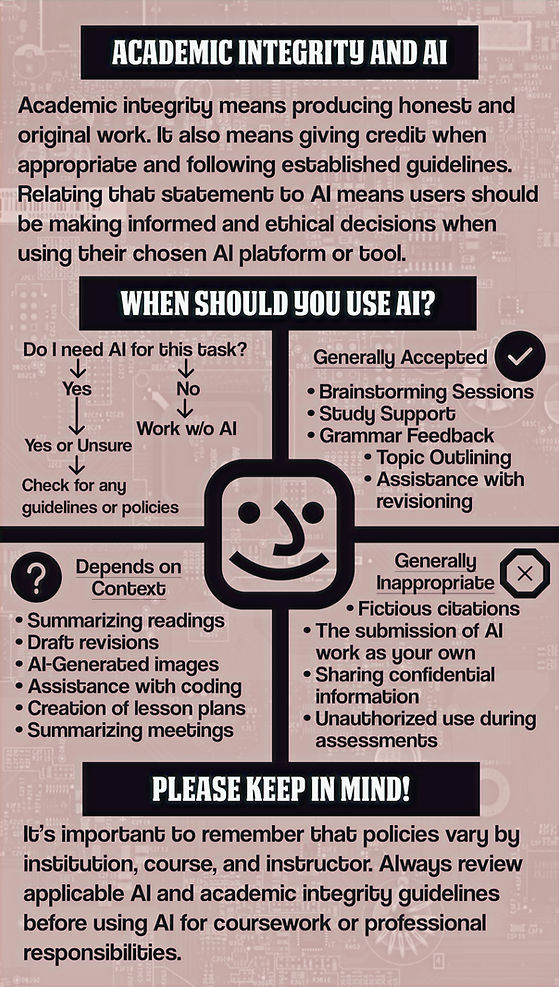
The first step users should take when using AI platforms/systems is to ask themselves, "Do I need AI for this task?" Using the decision tree to the left, users can determine whether AI should be used for a task. If yes, check for any guidelines or policies allowing the use of AI. If no, users should work without AI. It's a simple way to approach the use of AI.
In subsequent steps, users can follow the list below to help maintain academic integrity. This list keeps ethics and integrity at the forefront of all AI-related work.
-
Be Honest: Users should always represent their work accurately.
-
Be Transparent: If AI was used for work or to refine it, acknowledge your AI use when required by your instructor, institution, or even your employer.
-
Be Responsible: It’s essential to review, verify, and edit AI-generated content. This can help avoid falsehoods, misinformation, and AI-generated hallucinations. More on this can be found in the “Risks and Biases” section.
-
Protect Privacy: Users should avoid sharing confidential or sensitive information with AI systems. This can include addresses, student grades, and other personal information. It’s also recommended that users never enter or use any proprietary information within AI systems.
-
Follow Policies: Above everything else, users should know and follow their institution's AI and academic integrity guidelines. If these aren’t publicly available or accessible, users should simply consult the appropriate team/departments within their institutions.
Users can also consult the infographic to the left from Wichita State University. This graphic explains academic integrity versus AI. If offers more ways to uphold academic integrity when using AI.

Image provided by Wichita State University
Institutional AI guidelines, policies, and standards should include information on acceptable use. This should include what is and is not permitted when using AI. Both the "Academic Integrity and AI" above and the "Ethics Vs. Unethical AI Use" infographics from the Proctor Library at Flagler College below list several ways AI usage is and isn't acceptable.


Risks and Biases in AI
Artificial intelligence is changing and transforming the educational landscape. Platforms like ChatGPT, Claude, and Gemini are introducing newer and more advanced versions of their LLMs at a rapid pace. While AI is advancing, there are also significant challenges. Those challenges can be severe limitations without human involvement. The better humans are able to recognize those limitations and understand the impact that bias, misinformation, and privacy can have on AI use, the better results and experience will be.
AI is a powerful tool, but there are limitations.
As mentioned previously, AI systems generate responses using what’s available. Those systems can use large language models and other data to generate responses. However, if a prompt leads a conversation to a topic that the LLM doesn’t have enough information on, hallucinations can occur. Some responses may sound convincing but may contain incorrect, incomplete, misleading, or, in some cases, outdated information.
It’s important to remember that AI systems and platforms are not perfect.
For AI conversations to be successful, humans should be seen as the driver, with the AI as an assistant. Similar to what was written in the “AI101” section, humans must always be involved to guide a prompt and/or task. The human element is what keeps AI heading in the intended direction. Without that human touch, the AI can and will generate troublesome responses. These responses can carry various risks, and without a human involved, can go awry. Some of the most common risks are easy to spot and avoid.
The infographic below lists 4 common ones, like hallucinations, bias, privacy/confidentiality, and information verification. While those may be the risks chosen for this example, there are many more risks and biases related to AI. It also offers some remedies to combat those risks. It’s essential to stay vigilant in order to ensure chats and any subsequent responses avoid all risks related to AI.
A simple framework to ensure chats, prompts, and tasks are free from risks, bias, and other limitations is as follows:
Before using AI:
-
What is the purpose of using this AI platform or system?
-
Verify that institutional guidelines, policies, and standards permit the use of the chosen platform or system.
-
Choose the appropriate platform, system, or tool.
-
Choose the information the prompt or task will use.
-
Please note that no sensitive information should be shared as part of the process.
While using AI:
-
Always use clear prompts and questions to guide the conversation/task.
-
Always think critically of the responses received.
-
Be aware of any potential biases, incorrect information, or misinformation as part of the process.
After using AI:
-
Verify, verify, verify!
-
Always check citations and provide any relevant appropriations to sources.
-
Edit, personalize, and refine any responses.
-
Confirm that any information produced as part of the prompt/task meets institutional guidelines, policies, and standards.
Effective Prompting with AI
Prompting is a key component of most AI systems. It typically is a user giving an AI system a question, task, or other instruction as a way to guide a response. Prompts act as the input that users can use to direct the conversation in the way they would like. Effective prompting is a practice of writing clear, specific, and purposeful instructions.
Prompting in this manner is an iterative approach. Users can review and refine their instructions to an AI system to achieve the intended results. The main purpose of prompt refining is to generate the best results. It can also help reduce errors, hallucinations, and misinformation during the process. Approaching an AI system in this manner can allow users to efficiently and effectively work while promoting critical thinking and human oversight.
This approach can look something like this:
Prompt → AI Response → Review → Refine
Users can achieve optimal results by using clear, effective prompts. AI systems are designed to adapt during the process, so the more details users provide, the better the responses. When prompting, it’s important to provide clarity, context, and details, state the purpose, and be specific. Instead of using vague questions, prompts should provide context, define the desired outcome, and specify how information should be presented. The better a user’s prompt, the higher the quality and accuracy of the response.

Users can distinguish good from bad prompts by recalling the LEAD model from the “Ethical Use” tab. NC State’s DELTA division states, “Clear prompts can help generate examples that connect to learning objectives, improve assessment ideas, and create materials that are accessible for students.” Depending on the desired result, prompts can essentially be the building blocks to a conversation with any AI system. Chat-based platforms like ChatGPT, Claude, and even ones like Siri and Gemini are designed to work as places for conversation.
Following the CLEAR recommendations to the left can help guide a conversation to a user’s desired results:
-
C is for Context: Conversations work best when background information is provided. The more details provided, the better.
-
L is for Limitations: Clear boundaries and guidelines should be established for responses. Clear and concise guidelines work best.
-
E is for Expectations: Users should clearly state what an AI should do or how it should respond.
-
A is for Audience: Users should also define whom the response is intended for.
-
R is for Refine: Users are strongly encouraged to refine responses because very rarely is the first response the best.
A simple prompt template that follows the previous recommendations is as follows:
Role + Goal + Context + Task + Format + Constraints
The Future of AI in Education
This section does not serve as a speculative one. The aim of this section and infographic is to ensure users have future-ready skills. These skills work as a catalyst that can help expand human involvement and thinking. An important skill is flexibility in the time we find ourselves in regarding artificial intelligence. It’s becoming an integral part of the educational environment. It’s constantly changing and evolving. New GPT models are released every week. LLMs are refreshed, and new versions are released just like GPT models. It is vital that people remain in control and at the center of teaching and learning. Humans should always be active participants when using AI.
When using AI, it’s important to approach any platform and system with the mindset that AI is not a replacement for human expertise. It’s a tool users can utilize to enhance any number of human skills. From creativity to learning to productivity, AI can help enhance those skills and make them more efficient. How can users continue to grow and thrive as AI evolves? What are some skills users can develop to be future-ready for those advancements? These skills should serve as a foundation that helps users prepare for what AI may look like in the very near future.
Future-prepared users aren’t those solely focused on the technology itself. Future-ready users are those who educate themselves on valuable skills. While the list of skills can be lengthy, the infographic in this section focuses on four valuable skills. These skills are below on the infographic and in the accompanying text:

Critical Thinking: This skill helps users evaluate information, solve problems, and make better and more informed decisions. While AI can generate text, summarize information, and provide recommendations almost instantly, critical thinkers can fully understand context, ethics, and values. This skill can also help users determine whether an AI tool is applicable and useful for their problem or task. Without this skill, users could accept AI-generated content at face value. This could lead to errors and misinformation.
Creativity: This skill is important because creativity is inherently human. AI systems can generate text, images, code, and other ideas, but these systems do not possess imagination or human experience. These are valuable skills to have because without creativity, generated content could become stagnant. Without the ability to innovate, solve real-world problems, and produce meaningful content and work, AI systems lack the human touch that makes other ideas come alive.
Communication: While AI systems can generate emails, create summaries of various content and presentations, and even translate languages, they lack human skills such as clarity, empathy, and the essential skill of collaboration between different sets of humans. Communication is more than drafting content and providing real-time feedback. It’s human relationships that set these skills apart from generated content. While AI may be a routine tool, its success hinges on how well humans can communicate their ideas and collaborate with others.
Learning: Learning is shifting away from simply memorizing information and towards users adapting how they learn. Education has evolved from a cookie-cutter approach toward an adaptive, personalized, and learner-centered experience. There is a larger focus placed on positioning users to become lifelong learners. While AI can produce content and information, learning isn’t just about producing that information. It’s about acquiring skills that allow learners to more easily apply knowledge, solve problems, transfer valuable skills, and better understand concepts.
Users who are educated in the basics of AI, its applications, ethical implications, risks and biases, and how to best future-prepare themselves for a quickly changing landscape will be the ones best prepared for what may come. Responsible AI is not just about using what’s available in today’s AI landscape; it’s about developing skills that can adapt as AI evolves. It’s also about users collaborating with the tools and using human knowledge and skills to approach the use of AI with an ever-present ethical mindset.
Where necessary, content and imaging have been cited inline with the site text. The sources below were consulted in creating this project. Infographics created for this project used information from the sources below. Other infographics have been cited under each one. All other work was created, developed, and researched by Kevin Hardin over 2025 and 2026 as part of the Appalachian State University's Media, Technology, and Learning Design (or MTL) Graduate Program. Other cited works can be found below:
-
AI fluency: Prompting basics – teaching resources. (2025a). In Ncsu.edu. https://teaching-resources.delta.ncsu.edu/ai-prompting-basics/
-
AI literacy & ethics | the Derek Bok Center for teaching and learning. (2025b). In Harvard.edu. https://bokcenter.harvard.edu/ai-literacy-and-ethics
-
AI risk management framework | NIST. (2021). In NIST. http://nist.gov/itl/ai-risk-management-framework
-
AI vs. AI. (2026a). Wichita.Edu. https://www.wichita.edu/about/student_conduct/_images/Ai-v-AI-Extended-800.jpg
-
Anderson, J. (2023). AI in Education| Harvard Graduate School of Education. In www.gse.harvard.edu. https://www.gse.harvard.edu/ideas/edcast/23/02/educating-world-artificial-intelligence
-
Artificial intelligence in education. (2022). In Unesco.org. http://unesco.org/en/digital-education/artificial-intelligence
-
Department of Labor, U. (2026, February 13). The Department of Labor’s Artificial Intelligence Literacy Framework [PDF]. US DOL. https://www.dol.gov/sites/dolgov/files/ETA/advisories/TEN/2025/TEN%2006-25/Attachment%20I%20%28Accessible%20PDF%29.pdf
-
Department of Labor, U. (2026). Ten 07-25Training and Employment Notice No. 07-25. In DOL. https://www.dol.gov/agencies/eta/advisories/ten-07-25
-
Digital Education Council AI Literacy Framework. (2025c). In Digitaleducationcouncil.com. https://www.digitaleducationcouncil.com/post/digital-education-council-ai-literacy-framework
-
DOL, U. (2026, February 13). U.S. Department of Labor’s AI Literacy Framework [PDF]. US DOL. https://www.dol.gov/sites/dolgov/files/ETA/advisories/TEN/2025/TEN%2006-25/Attachment%20II%20%28Accessible%20PDF%29.pdf
-
Empowering Learners for the Age of AI. (2026b). ODCE/ European Union. https://chooser.crossref.org/?doi=10.1787%2F65cd27d4-en
-
Generative pre-trained transformer Wiki. (2023a). In Wikipedia. https://en.wikipedia.org/wiki/Generative_pre-trained_transformer
-
Guidelines for responsible use of AI - information technology at Johns Hopkins. (2025d). In Information Technology at Johns Hopkins. https://it.johnshopkins.edu/ai/guidelines-for-responsible-use-of-ai/
-
Healey, M. (2025). The pros and cons of AI in education: Benefits, risks, and real examples | discovery education blog. In Discovery Education. https://www.discoveryeducation.com/blog/educational-leadership/ai-in-education/
-
Hough, L. (2023). Students: AI is part of your world | Harvard Graduate School of Education. In www.gse.harvard.edu. https://www.gse.harvard.edu/ideas/ed-magazine/23/05/students-ai-part-your-world
-
IBM watsonx as a service. (2025e). In Ibm.com. https://www.ibm.com/docs/en/watsonx/saas?topic=atlas-hallucination
-
IBRAHIM, A. (2026). Making AI work for people. Making AI Work for People. https://doi.org/10.1002/9781394406463
-
ICAI | home page. (2025f). In Academicintegrity.org. https://www.academicintegrity.org/aws/ICAI/pt/sp/home_page
-
Klein, E. (2025). The pros and cons of AI in education | ACE blog. In American College of Education. https://ace.edu/blog/pros-and-cons-ai-in-education/
-
kpierce. (2024, December 6). Advancing AI literacy on campus: A 4-Pillar approach for educators - alchemy. Alchemy. https://alchemy.works/advancing-ai-literacy-on-campus-a-4-pillar-approach-for-educators/
-
Kritik - why AI literacy is the key to ethical AI use in higher education. (2025g). In Kritik.io. https://www.kritik.io/blog-post/why-ai-literacy-is-the-key-to-ethical-ai-use-in-higher-education
-
MIT Management. (n.d.). Effective prompts for AI: The essentials. In MIT Sloan Teaching & Learning Technologies. Retrieved August 4, 2026, from https://mitsloanedtech.mit.edu/ai/basics/effective-prompts/
-
Poth, R. D. (2025). Building future-ready students: Embracing AI, adaptability, & innovation in education. In Defined - Blog . https://blog.definedlearning.com/building-future-ready-students-embracing-ai-adaptability-and-innovation-in-education/
-
Principles for responsible use of AI | ncdit. (2025h). In Nc.gov. https://it.nc.gov/resources/artificial-intelligence/principles-responsible-use-ai
-
Proctor Library: Generative AI ethics and ethical use in academic contexts: Academic integrity & AI: Understanding the line. (2025i). In Libguides.com. https://flagler.libguides.com/c.php?g=1449135&p=10980123
-
Ross, E. (2023). Embracing artificial intelligence in the classroom. In Harvard Graduate School of Education. https://www.gse.harvard.edu/ideas/usable-knowledge/23/07/embracing-artificial-intelligence-classroom
-
Sal Khan on innovations in the classroom | Harvard Graduate School of Education. (2023b). In www.gse.harvard.edu. https://www.gse.harvard.edu/ideas/education-now/23/01/sal-khan-innovations-classroom
-
Stryker, C., & Kavlakoglu, E. (2024). What is artificial intelligence (AI)? In IBM. https://www.ibm.com/think/topics/artificial-intelligence
-
University of San Diego. (2025). 39 Examples of artificial intelligence in education. In University of San Diego. https://onlinedegrees.sandiego.edu/artificial-intelligence-education/
-
Van Der Putten, P. (n.d.). The AI Manifesto. PEGA. Retrieved https://www.pega.com/the-ai-manifesto?utm_source=google&utm_medium=cpc&utm_campaign=G_US_NonBrand_AI_CE_Exact_(CPN-108049)_EN&utm_term=responsible%20ai&gloc=9009595&utm_content=pcrid|707669874375|pkw|kwd-412841098974|pmt|e|pdv|c|&gclsrc=aw.ds&gad_source=1&gad_campaignid=16260883825&gbraid=0AAAAAD_i2S3G97ZJsLLNQB_EWXMHRiAcB&gclid=Cj0KCQjw-MDTBhCgARIsAKAkdlT4RW6DiXq5MY-i_93w1PUUBbao9vDZd4oYJAnHqG3RW4SogDXWlXwaAgovEALw_wcB