

Technology for Social Good Project
Technology for Social Good Project
Develop a plan for implementing an emerging technology for 'social good' – applied to societal problems – in a field such as education, public health, or elderly care. This plan should include:
-
A description of the targeted social change/potential benefit
-
An overview of the type of technology selected and the reasoning behind the selection
-
A brief summary of related literature related to the need for this change and the potential use of technology in the initiative (References should follow APA 7th edition)
-
A table or other graphic outlining the plan, including: the primary goal, specific objective(s), strategies relating to these objectives, responsibility for implementation of strategies, resources required, timeline, and benchmarks/indicators of success.
-
You may present your project in a format of your choice.
-
You will also produce a short overview video or infographic outlining your plan, which will be posted to the discussion board for peer feedback. Please include a link to this on your final project submission.
1. Synder, S. (2023, August 18). The Challenges Associated with Technology in Schools – Smart Strategies for Successful living. Smart Strategies for Successful Living.
https://www.agegracefullyamerica.com/the-challenges-associated-with-technology-in-schools/
This article details the major obstacles in an educational environment. Although technology can continually advance and improve the learning experience, there are still several challenges in implementing it. The article then goes on to describe several of those issues, including access and equity disparities, the need for professional development, infrastructure-related problems, and digital distractions. The article makes a great case for pushing schools to address these concerns to provide equitable access to education actively.
2. Haleem, A., Javaid, M., Qadri, M. A., & Suman, R. (2022). Understanding the role of digital technologies in education: A review. Sustainable Operations and Computers, 3, 275–285. https://doi.org/10.1016/j.susoc.2022.05.004
This article discusses how sustainable development, particularly in educational access, is becoming an increasingly essential practice in teaching and learning. It also discusses specific digital tools, LMS platforms, and other online platforms, and their application within the instructional environment. The push for these technologies seeks to modernize the delivery, ease, and focus of the learning experience. The success of implementation depends on the facilitation of instruction, and that success is tied directly in with student/learner-centered experiences.
3. López, M. V. S., Riofrío, M. C. O., Barriga-Fray, S. F., & Viteri, B. S. P. (2025). Technologies in Inclusive Education: Solution or Challenge? A Systematic review. Education Sciences, 15(6), 715. https://doi.org/10.3390/educsci15060715
The article presents research on how technologies are used to support inclusive education for students with disabilities and other diverse needs. The research in this article evaluates whether the technology here can aid or create challenges for inclusity in education. The research, conducted over 5 years, includes studies to identify the technologies used and any benefits or obstacles encountered as part of the educational process. As part of the research, the studies also evaluated assistive tools, platforms/tools utilizing interactivity, and emerging technologies, such as virtual/augmented reality. Results show that the technology used during the research period can be helpful when implemented carefully and thoughtfully.
4. Mullin, C., Gould, R., & Parker Harris, S. (2021). ADA Research Brief: Digital Access for Students in Higher Education and the ADA (pp. 1-12). Chicago, IL: ADA National Network Knowledge Translation Center. https://adata.org/research_brief/research-brief-digital-access-students-higher-education-and-ada
This article discusses the digital divide in higher education. It also details the implementation of specific laws governing disability rights and digital access across higher education institutions. It notes that disparities can create different online experiences for users with and without disabilities. However, just having disability-rights laws isn’t enough. To meet ADA guidelines and ensure equal access, both in-person and online learning experiences must be intentionally designed. Those can include developing campus resources with accessibility and inclusivity in mind, investing in training opportunities, and providing an equity of access within the learning experience.
5. Casiello, Andy. (2024, November 11). Using technology to transform higher education. UPCEA. https://upcea.edu/using-technology-to-transform-higher-education/
To positively transform education, institutions must embrace digital transformation. Student expectations are constantly on the rise and the demand for more flexible learning capabilities and technologies increases more each year. To meet those, it’s essential to deliver personalized, accessible, and engaging learning experiences. Technological integrations can be complex for a variety of reasons. These can include
bureaucratic structures, resistance to change, limited resources, and difficulties in decision-making.
One of technology’s most transformative impacts is the ability to enable personalized learning. Using platforms such as Canvas or other LMS systems, we can tailor learning to each learner. Another meaningful way the learning experience can be influenced is by engaging instructors. The hope is that, by doing so, facilitators can overcome future impediments.
6. Eisenmann, D. (n.d.). Accelerating changes needed in education. https://thenexttechthing.blogspot.com/2017/08/accelerating-changes-in-education.html
With technology advancing at a seemingly exponential rate, humans can often have difficulties adapting. Humans must find ways to adapt. To do so, humans must adopt a lifelong learning mindset. For that to happen, schools and educators need to change their attitude. This includes embedding agile, experimental, adaptive learning, and encouraging students to embrace change, failure, and continuous growth. Another point directly related to my presentation is that accessibility and equity are critical as powerful technologies are emerging more frequently.
7. Mulford, D. AI in Higher Education: A Meta Summary of Recent Surveys of Students and Faculty – Campbell Academic Technology Services. (2025, March 6). Campbell Academic Technology Services https://sites.campbell.edu/academictechnology/2025/03/06/ai-in-higher-education-a-summary-of-recent-surveys-of-students-and-faculty/
The article details the results of a 2024 study on AI use in higher education by both faculty and students. Students’ use of AI was varied, including the use of writing assistants, the use of research and writing tools, and using AI-chatbots to aid in their studies. While AI was widely used, some users felt there was a lack of confidence in the learning environment regarding its use. Lastly, the study details potential concerns and implications of how AI would reshape the delivery and reception of learning.
Modern classroom technologies have advanced so much in the last several years. Technology managers, designers, and technicians often deploy technologies that just work. Sometimes it's assumed that the newest models will address all the issues. However, not all technologies work for every user. Faculty, staff, and students all have individual needs regarding the user experience. There is no "one size fits all" approach to technology.
The technology provided, and user needs, can best be described as the digital divide. Like with anything, there should be checks and balances or other ways to ensure the digital divide is addressed and bridges are built. Providing accessible and equitable services should be a standard process. Designing fully accessible and future-prepared presentation technology packages can be difficult.
The purpose of this project is to develop an AI-enabled platform to assist with the design process. Entitled the "AI-User Experience Assistant" or "AIUXA", this platform will serve as a way to assist with ensuring installed technologies are accessible to any and all users regardless of ability. This platform will also assist with ensuring technology standards meet ADA guidelines and other AV/IT industry standards.
Please note: This project is not designed to be used directly by end users. This is intended to be a platform used in the design, development, and implementation phases of new technology installations and refresh projects. It's intended for this platform to assist with planning and designing technology packages to ensure these meet accessibility standards established as part of the campus classroom standards documentation.
This infographic is a simplified version of the Change Canvas. I wanted to present the information in a simple, effective way, covering as much detail as possible while keeping the infographic easy to read. The information presented is pulled directly from the project's change canvas.


I used this system change canvas to develop my plan and path for success. The canvas begins on the left with the "Primary Goals", which feed into the "Objectives" and the specific "Strategies" for the project. Each section of the change canvas feed into a different section of the project itself. All the steps listed are equally important because they determine a task(s) related to the project's execution.





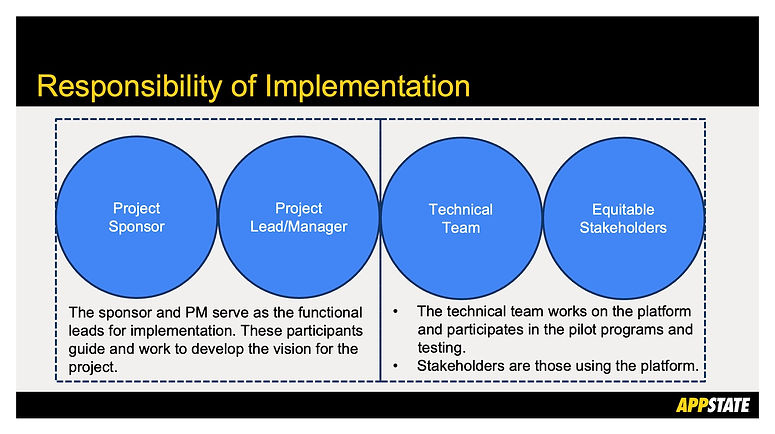


Image citation: “Appalachian State University.” CollegeVine, 2025, www.collegevine.com/schools/appalachian-state-university. Accessed 6 Mar. 2025.